Immigration is undoubtedly one of the most fundamental issues that will decide the outcome of the UK Referendum on EU membership, and arguably one of the most misunderstood and mispresented. As part of the University of Birmingham’s programme of events in the run up to the EU Referendum , the Institute for Research into Superdiversity... Continue Reading →
Why are unaccompanied migrant children disappearing in the thousands?
Until the EU recognises the specific needs of child migrants and makes it a priority to swiftly reunite them with family members, Nando Sigona and Jenny Allsopp argue in an op-ed published in OpenDemocracy, many will likely continue to abscond from the reception system. The ‘disappearance’ of 10,000 migrant children after arriving in the EU... Continue Reading →
It’s the culture, stupid! Or is it?
By Thomas Hylland Eriksen The events in Cologne have sparked controversies across Europe. This time, the topic is not the economic and social costs of the refugee crisis, but questions concerning culture and gender. We need a proper language in which to address these issues. There is no simple answer as to what exactly happened... Continue Reading →
Last two days to submit an abstract for IRiS conference
Last few days to submit an abstract for Frontiers and Borders of Superdiversity to be held at the University of Birmingham on 23-24 June 2016. The aim of the conference is to map the state of the art in knowledge on superdiversity and reflect on the analytical and heuristic uses of the concept, its potential... Continue Reading →
Intersecting Immigration Discourses in the UK, Germany and Russia
By Szymon Parzniewski and Anja Benedikt This ESRC-funded conference included high profile speakers from the UK, Germany and Russia who shared their research on immigration discourses and immigrants in different cultural, historical and political contexts. The interdisciplinary event was organised by PhD students and supported by the Institute for Research into Superdiversity (IRiS) and the... Continue Reading →
Where is integration in the refugee crisis?
What is lost in the debate about refugees, which has hitherto focused on numbers, is a proper discussion about integration. In this article, Jenny Phillimore examines the steps that might support a two-way integration process.
Time to rethink integration for an era of superdiversity
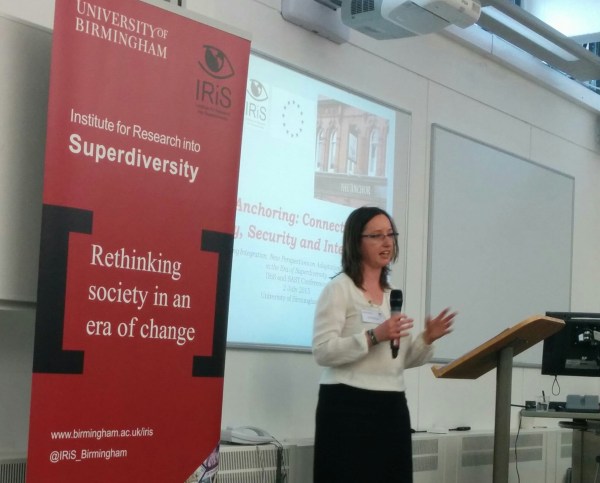
By Jenny Phillimore, Director of IRiS Last week saw 70 academics from across the globe come together for the second IRiS conference and, in a departure from what will become our usual format of an international biennial interdisciplinary conference, this day conference focused upon a single area of theory and policy: integration. The inspiration for... Continue Reading →
Ya’ Gotta’ love baseball: Resource caravan passageways and immigrant integration – distinguished lecture
Time & Venue: 2nd July, 5.30 pm, Room G15, Muirhead Tower, University of Birmingham Personal, social and material resource loss and gain is instrumental in immigrant life and host-immigrant conflict. Using the "love of baseball" metaphor, which has long been a standard for immigrant acceptance in the United States, Professor Stevan Hobfoll (The Judd and... Continue Reading →
Rethinking integration: New perspectives on adaptation and settlement in an era of superdiversity
IRiS and SAST Conference, Birmingham 2 July 2015 The Institute for Research into Superdiversity (IRiS) at the University of Birmingham, together with the project Social Anchoring in Superdiverse Transnational Social Spaces (SAST) is organising a one-day interdisciplinary conference which will focus upon theories on and research into adaptation and integration in an era of superdiversity.... Continue Reading →
Migration, social networks and integration: new IRiS Working Papers out
Two new IRiS Working Papers (no. 6 and 7) exploring issues related migration, social networks and integration policy and practice are out today. Using a wide range of literature, Dr Marta Kindler and colleagues (IRiS WP no. 6) focus upon the ways in which social networks and social capital have been found to promote or... Continue Reading →