
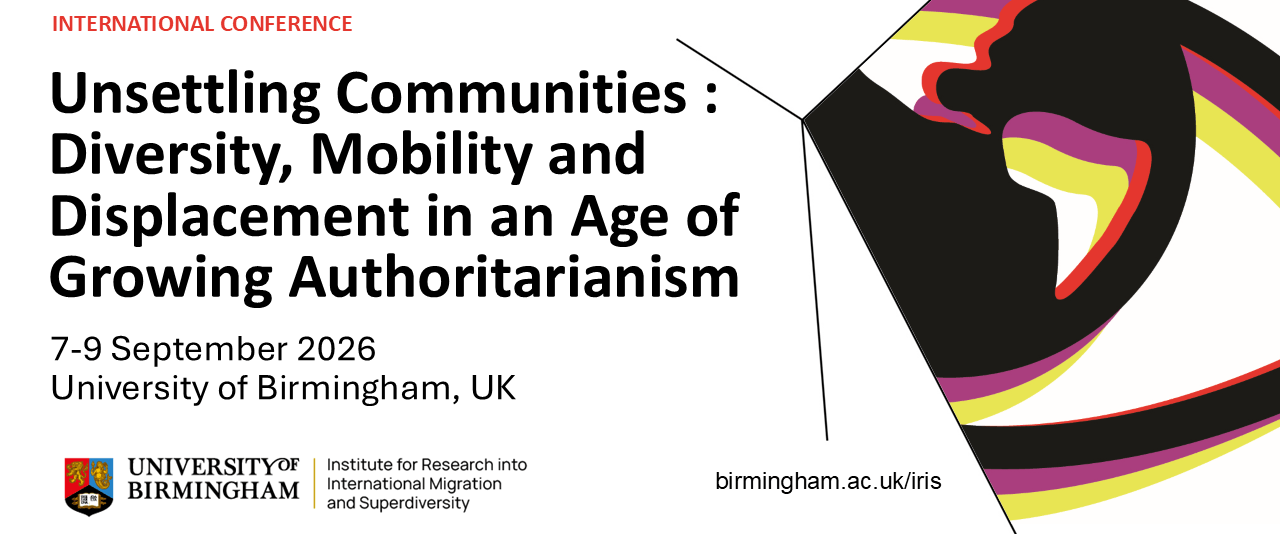
- 🆕Outline Programme* (2 Sept)
- 🆕Full Programme* (2 Sept)
- 🆕 Book of Abstracts* (2 Sept)
- 🆕 Code of Conduct
Confirmed plenary speakers include:
- Professor Anna Amelina (Chemnitz University of Technology)
- Zoe Bantleman (immigration barrister, JUSTICE)
- Professor Ernesto Castaneda (American University, Washington DC)
- Professor Jonathan Darling (Durham University)
- Professor Ipek Demir (University of Leeds)
- Professor Adrian Favell (University College Cork)
- Dr Amani Hassani (Brunel, University of London)
- Professor Rachel Humphris (Queen Mary, University of London)
- Dr Cetta Mainwaring (University of Edinburgh)
- Dr Lucy Mayblin (University of Sheffield)
- Dr Mihnea Cuibus (Migration Observatory, University of Oxford)
- Danai Papachristopoulou (Refugee and Migrant Centre)
We are living in times where profound and intersecting geopolitical, economic, environmental and ideological crises are shaping diversity, mobility and displacement. Armed conflicts and protracted wars — from Ukraine to Gaza —continue to displace millions, while climate breakdown, a widespread drift towards authoritarian rhetoric and far-right politics alongside economic collapse drive large-scale mobility and immobility across and within regions, including from Venezuela, across the Sahel, and throughout Central America. The current world order is thus increasingly characterised by change and instability. These changes have major ramifications including intensifying border violence, the introduction of increasingly selective mobility regimes and the erosion of international protection frameworks. Faced with this disruption, political and activist communities are forging new alliances across difference and mobilising in radical new ways to re-imagine collective power and belonging.
Globally, migration has become a central terrain of political contestation. Anti-immigration politics, resurgent racisms and exclusionary nationalisms are increasingly mainstreamed, accompanied by the targeting of racialised citizens and migrants through policing, surveillance, welfare restriction and labour market control. In the US, renewed violent attacks on migrants and their allies, the expansion of enforcement and detention, and assaults on DEI initiatives signal a broader backlash against those perceived as non-white. In Europe and the UK, similar dynamics unfold through externalisation, border violence, deterrence, and the normalisation of emergency governance.
These developments coincide with sustained attacks on international human rights norms and institutions, including the UN refugee regime, the humanitarian work of WHO and IOM, humanitarian law and the principle of asylum itself. The result is a deeply uneven landscape of mobility and immobility, where protection is increasingly conditional, racialised and politicised and the wellbeing of the mobile and the immobilised is undermined.
In this context, the study of diversity, migration and displacement is both more urgent and more challenging than ever.
- How can scholarship respond to these transformations without reproducing dominant framings of crisis, threat or invasion?
- What concepts, methods and alliances are needed to understand—and contest—this moment?
The themes of the conference speak to IRIS’s core research concerns around diversity, belonging, mobility and displacement, understood as historically grounded, politically contested and unevenly lived.
The conference will include plenaries, semi-plenaries, roundtables, panels and workshops. Parallel panels will be allocated a 90-minute slot, with each paper given 15 minutes to allow sufficient time for questions and discussion. Workshops will be allocated a 60-minute slot.

Conference fees, travel and accommodation are covered by participants. We offer reduced registration fees for eligible participants, including doctoral researchers, civil society representatives, migrant and refugee organisers, and attendees who do not have access to institutional or external financial support for conference participation. Standard full conference pass is £250/reduced £175. One-day conference pass is £150/reduced £100. Registration is now closed.
For further information, please contact School of Social Policy and Society Event Team: spsevents@contacts.bham.ac.uk
Where to stay
Here a page with hotels, B&Bs and guest houses in Birmingham city centre and closer to campus for delegates.
How to reach us
The PHD sessions and the welcome drinks (7 September) will be held on our main campus in Edgbaston. Please find here directions and map of the campus.
On 8 and 9 September, the conference will be held at The Exchange building in Birmingham city centre. Please find here how to find The Exchange
*Conference Programme and Book of Abstracts may be subject to change


