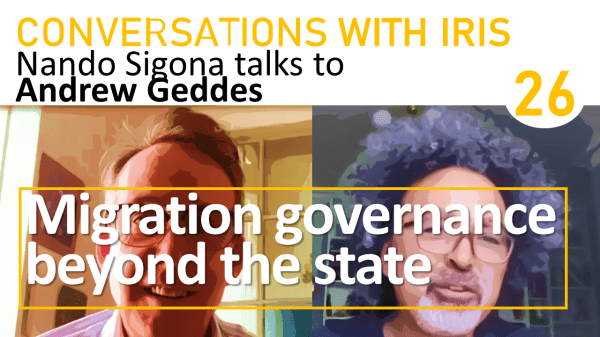
In the new episode (#26) of Conversations with Iris, Nando Sigona talks with professor Andrew Geddes, director of the Migration Policy Centre at the European University Institute, about his recent book 'Governing migration beyond the state' (Oxford University Press). The conversation explores the role of regional actors in migration governance and how responses to mobility... Continue Reading →
Mapping the field: Journal of Ethnic and Migration Studies
We are pleased to launch a new series of blog posts aimed at providing insights into the key themes, centres of production and geographical foci in migration studies today through an analysis of the coverage of some of the key academic journals in the field. The series is written and researched by the students on... Continue Reading →
Mobility and migration after Covid-19: webinar on 7 July, 2pm (BST)
>Webinar is free and open to the public, please register here. What role will physical and social mobility infrastructures play in shaping future post-pandemic societies globally and locally? How can connectedness between different types of mobilities contribute to solve global challenges and create more sustainable cities and societies? Mobility of goods, services and people shapes the way that we use and... Continue Reading →
Surviving Covid-19 as vulnerable migrants in Japan and the UK (video)
Watch the recording of the NODe UK|Japan webinar held on 21 April 2021 on the impact of Covid-19 on migrants with precarious legal status in the UK and Japan. The speakers examined how migration governance in the context of a public health crisis can exacerbate existing vulnerabilities and produce new ones, affecting disproportionally migrant communities... Continue Reading →
Precarious migrants and access to health care in Japan and the UK (video recording)
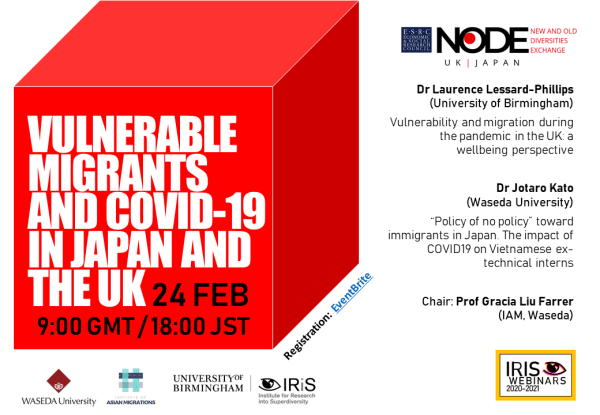
This is the video recording of the first NODE UK|Japan webinar on vulnerable migrants and Covid-1p with Dr Laurence Lessard-Phillips (IRiS, University of Birmingham) and Dr Jotaro Kato (IAM, Waseda). The webinar is chair by professor Gracia Liu Farrer, director of the Institute of Asian Migrations (IAM) at Waseda University. https://www.youtube.com/watch?v=y4TEe15TAPY
Brexit, viral borders and vaccine nationalism
By Michaela Benson (@michaelacbenson) and Nando Sigona (@nandosigona) (Originally published in The Sociological Review) Three weeks into 2021 and the end of the Brexit transition period, and not a day has passed where the borders haven’t made their presence felt in the news cycle. The coincidence of COVID and Brexit has produced a perfect storm,... Continue Reading →
Rethinking integration after Brexit: Adrian Favell in Conversation with Iris (Part 2)
Here the second part of Nando Sigona's interview with Adrian Favell on Brexit, free movement and the return to ‘integration’. https://www.youtube.com/watch?v=Z4w97sy-EKs
Political demography, Brexit and the borders of membership: Adrian Favell in ‘Conversation with Iris’
How has Brexit redrawn the boundaries of membership in the UK? IRiS director Nando Sigona talks to professor Adrian Favell (University of Leeds) about the ESRC-funded Northern Exposure project on the impact of Brexit on northern towns and small cities, and how the end of freedom of movement doesn't mean less immigration, but immigration with... Continue Reading →
Racism, migration and the US election: Jenny Phillimore in conversation with Chip Gallagher
Jenny Phillimore talks to Chip Gallagher (LaSalle University, US) about immigration and racism and how they are shaping voting behaviours in the US Election as well as the prospects for change with the election of a Biden/Harris-led government. https://youtu.be/v0tq1vR2R7o Chip Gallagher is professor of sociology at LaSalle University, US. His research focuses on social inequality,... Continue Reading →
When people who haven’t moved are called ‘migrants’: Considerations for implementing Objective 4 of the Global Compact for Migration
Tendayi Bloom (@TendayiB) In December 2018, the Global Compact for Migration was adopted by the United Nations General Assembly. The headline of the fourth of its 23 objectives is as follows: ‘Ensure that all migrants have proof of legal identity and adequate documentation’. Considering this objective in detail indicates that it is often documents (or... Continue Reading →