We asked our researchers to pick one of their publications from 2025 and share why it stands out for them. Here's what they replied!1) Let's start with the introduction to a Special Issue on "#RefugeeSponsorship & Complementary Pathways" edited by our refugee sponsorship research team (Jenny Phillimore, Marisol Reyes, Gabriella D'Avino, Natasha Nicholls). It's the... Continue Reading →
Most Britons vastly overestimate the number of irregular migrants, new research shows
A new report has revealed major gaps in UK public understanding of irregular migration, which is shaped by political media narratives rather than facts. A new report published today (11 December), by researchers at the University of Birmingham, reveals widespread misconceptions among the UK public about irregular migration, which includes all unauthorised methods of entering... Continue Reading →
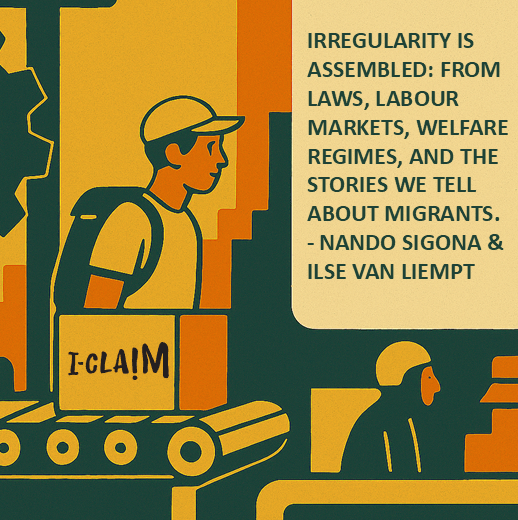
Irregular migration as an assemblage: New IRIS Working paper unpacks how “irregularity” is made in Europe
Written by Nando Sigona (University of Birmingham) and Ilse van Liempt (Utrecht University), The irregularisation of migration and migrants’ irregular condition: an assemblage perspective draws on research across six European countries — Finland, Germany, Italy, the Netherlands, Poland and the United Kingdom — carried out as part of the I-CLAIM project, to propose a new way of thinking... Continue Reading →
Conversations with Iris is back: Mariko Hayashi in conversation with Seb Rumsby
Mariko Hayashi, Executive Director at Southeast and East Asian Centre (SEEAC) talks to IRIS Seb Rumsby about the challenges facing Southeast and East migrants and diasporas based in the UK, before comparing post-Brexit UK with East Asian labour migration regimes to explore how policies lead to labour migrant exploitation and rights abuses and what can... Continue Reading →
Precarious migrants and access to health care in Japan and the UK (video recording)
This is the video recording of the first NODE UK|Japan webinar on vulnerable migrants and Covid-1p with Dr Laurence Lessard-Phillips (IRiS, University of Birmingham) and Dr Jotaro Kato (IAM, Waseda). The webinar is chair by professor Gracia Liu Farrer, director of the Institute of Asian Migrations (IAM) at Waseda University. https://www.youtube.com/watch?v=y4TEe15TAPY
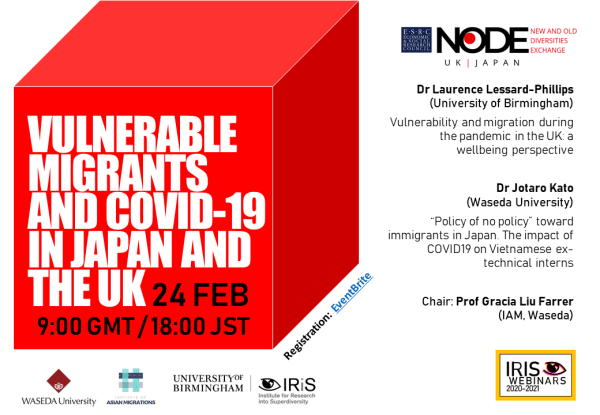
Vulnerable migrants and Covid-19 in the UK and Japan: NODE UK|Japan webinar
Registration: https://www.eventbrite.co.uk/e/vulnerable-migrants-covid19-in-japan-and-the-uk-900-gmt1800-jst-tickets-138755584689 This jointly organised webinar explores the impact of Covid-19 on migrants with precarious legal status in the UK and Japan. It examines how migration governance in the context of a public health crisis can exacerbate existing vulnerabilities and produce new ones, affecting disproportionally migrant communities already at the margin of our societies. Speakers:... Continue Reading →
Irregular migration and the new global governance of human mobility
In this interview, Dr Nando Sigona offers some insights in the changing nature of undocumented migration and how the UN global compact agenda may contribute to further exclude the migrants it claims to protect. Dr Sigona draws on research carried out with colleagues for the ESRC-funded MEDMIG project and his previous work on irregular migration... Continue Reading →
Why are unaccompanied migrant children disappearing in the thousands?
Until the EU recognises the specific needs of child migrants and makes it a priority to swiftly reunite them with family members, Nando Sigona and Jenny Allsopp argue in an op-ed published in OpenDemocracy, many will likely continue to abscond from the reception system. The ‘disappearance’ of 10,000 migrant children after arriving in the EU... Continue Reading →
Everyday borders – film and discussion
IRiS is hosting a screening of the documentary 'Everyday Borders' (dir. Orson Nava) followed by a panel discussion on 19 November, 5-7pm (Room LT1, Strathcona Building, University of Birmingham - see map). The film tells the story of how increasing numbers of people are being obliged to act as border-guards in the communities where they... Continue Reading →