
by Nando Sigona, University of Birmingham, UK
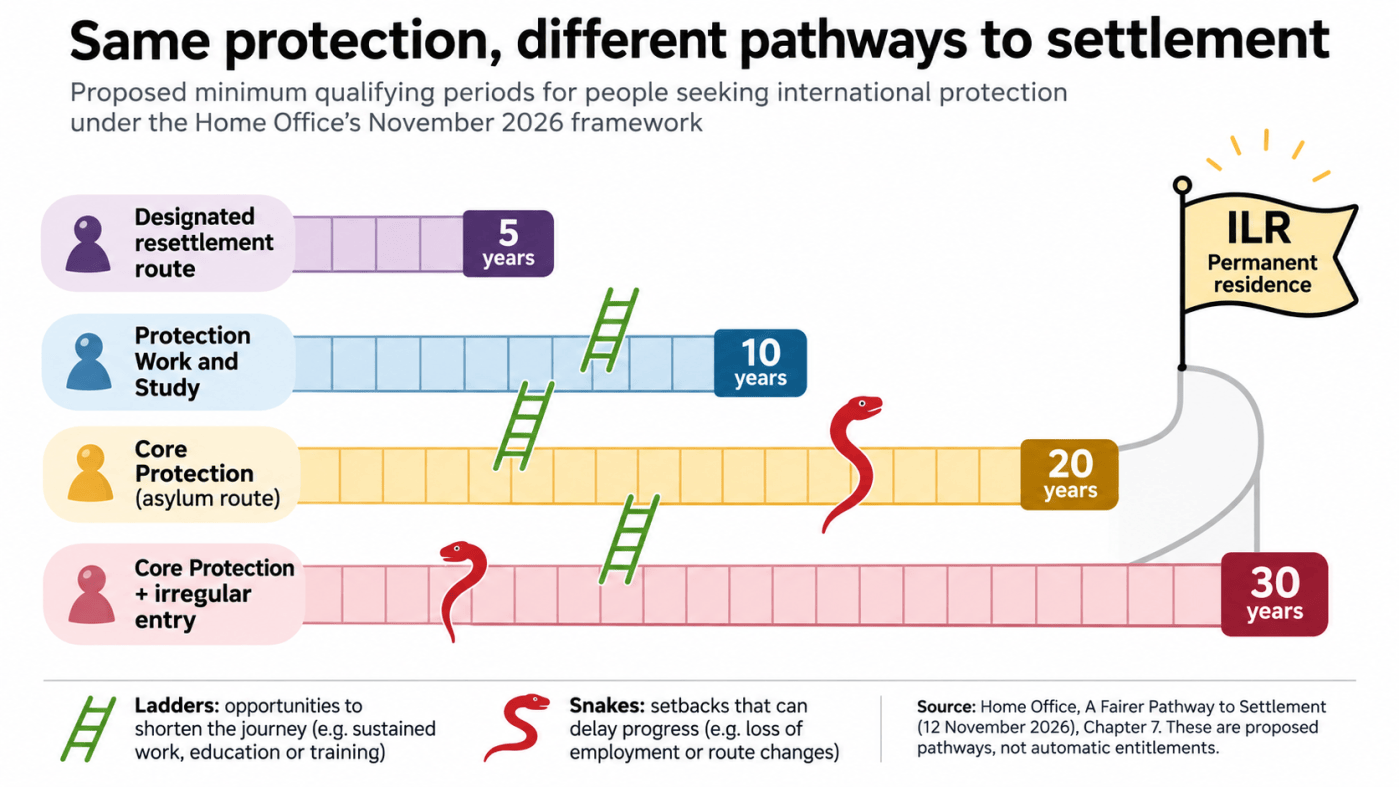
On 12 November 2026, the Home Office published its response to the consultation on earned settlement, setting out a new framework for how migrants will qualify for permanent residence in the UK. The proposals brought to mind a familiar board game: Snakes and Ladders. But imagine a version in which not everyone plays by the same rules.
In this game, participants are assigned different pathways to the same destination: indefinite leave to remain (ILR). Some have a relatively short journey, others face a much longer one. Some can climb ladders through higher earnings, particular occupations or other recognized contributions. Others encounter snakes that delay their progress, sometimes dramatically. And the rules can change while people are already playing, moving the finish line further away, and in a few cases closer.
The government’s proposed settlement pathways for people seeking international protection illustrate this particularly clearly.
Under the new framework, refugees arriving through designated resettlement routes could qualify for settlement after five years. Those granted protection after claiming asylum in the UK would ordinarily face a 20-year pathway. Moving into sustained work, education or training could open a ten-year route, but the clock would restart on entering that pathway. People who entered the UK irregularly could face an additional ten years, subject to safeguards under Article 31 of the Refugee Convention. The same need for international protection can therefore lead to radically different prospects for permanent settlement.
But the inequalities of this game are not simply a matter of different waiting times or individual circumstances.
Earned settlement resembles a game of Snakes and Ladders in which participants are assigned different pathways, distances and penalties. Yet these differences are not merely technical features of immigration law. The rules emerge from historically constituted hierarchies of mobility, labour and belonging, and can reproduce racialised inequalities even when they make no explicit reference to race. Players do not simply experience the game differently because of who they are; the game itself participates in producing the categories and hierarchies through which they are governed.
This is a central argument of our recent I-CLAIM report, Racial Logics of Irregular Migration in Europe: Policy, Perception, and Precarity. Drawing on research across six European countries, we show how immigration rules, labour regimes, bureaucratic practices and public narratives interact to produce racialised inequalities in access to rights, labour market and settlement opportunities.
In written evidence to Parliament’s inquiry on routes to settlement, I argued that prolonged and conditional pathways to permanence generate insecurity, constrain employment opportunities and affect families and communities. Settlement is not simply a reward for successful integration; security of status can itself enable people to build stable lives and participate fully in society.
The language of earned settlement suggests a competition in which progress reflects individual effort and contribution. But what does it mean to earn settlement when the distance to the finish line, the available shortcuts and the consequences of setbacks are so unequally distributed? And what happens when the rules change while people are already playing? We will explore these questions in our new research on Temporary Migration and Conditional Settlement in Post-Brexit Britain, funded by the Nuffield Foundation as part of the Racial Diversity UK programme. The research is a collaboration between IRIS at the University of Birmingham, COMPAS at the University of Oxford, Migrant Voice and the Work Rights Centre.


Leave a Reply