David Stark and Lisa Goodson, IRIS, University of Birmingham A policy turning inwards At the Institute for Research into International Migration and Superdiversity (IRIS), we examine migration and superdiversity through empirical research grounded in lived experience. We do this from Birmingham, one of the UK’s most ethnically diverse cities and a place where migration is... Continue Reading →
What a Trump presidency means for millions of migrants and their families in the US
Nando Sigona, University of Birmingham The immigration debate has long shaped political agendas in the US and Europe, often escalating in times of social or economic uncertainty. In the US election, a tough-on-immigration stance from president-elect Donald Trump, including promises of mass deportations, appears to have resonated with voters. History shows that these policies may... Continue Reading →
IRIS director elected Fellow of the Academy of Social Sciences
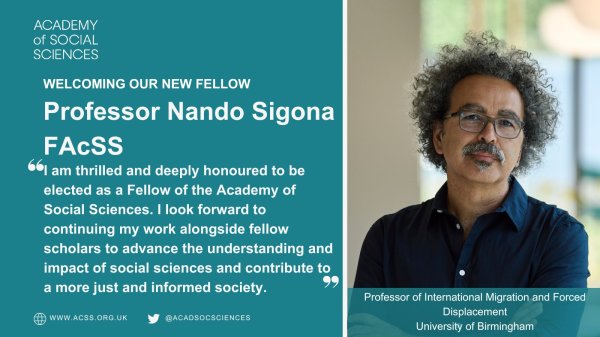
The Academy of Social Sciences is delighted to welcome 45 leading social scientists to our Fellowship this autumn. Spanning a range of research and practice areas including urban governance and public policy, health technology assessment, hunger and food insecurity, migration and forced displacement, and international law, our newly elected Fellows highlight the importance, breadth and... Continue Reading →
One week to IRIS conference
Check out the latest version of the Conference programme, which includes 33 panels, 5 workshops, 4 semi-plenaries and two keynote talks by Nandita Sharma and Nasar Meer. The code of conduct for delegates is also online on our conference page. The book of abstracts is now online!
Who really benefits from international labour migration? New IRIS Working Paper on the everyday political economy of labour migration
By Seb Rumsby IOM World Migration Report 2024 found that international remittances had increased 650% from $128bn to $831bn between 2000 and 2022. This growth continued contrary to predictions that remittances would drop dramatically during COVID-19. Remittance figures now outnumbers foreign direct investment in developing nations for the first time, highlighting the critical importance of labour... Continue Reading →
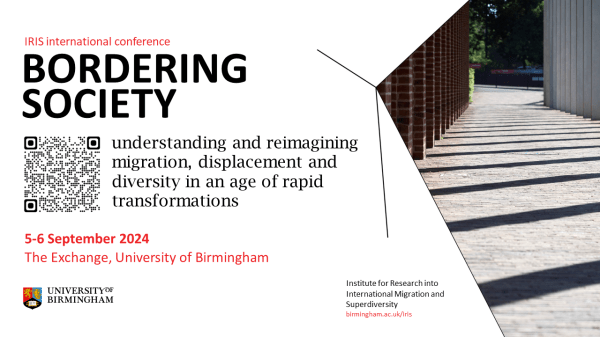
Bordering Society: Understanding and Reimagining migration, displacement and diversity in an age of rapid transformations – CALL FOR PROPOSALS
The Call for Proposals for individual papers, pre-organised panels and workshops for IRIS international conference to be held at The Exchange, University of Birmingham on 5-6 September 2024 is open. Deadline to submit proposal via the online portal is 27 March 2024. Rapidly shifting geopolitical alliances and power asymmetries in an increasingly multipolar landscape rekindle... Continue Reading →
New report reveals real life experiences of Hong Kongers and Ukrainians in the UK under government’s ‘safe and legal humanitarian routes’
New report titled "Humanitarian Visas in a Hostile Environment" offers first-hand insights into the experiences of individuals arriving in the UK through the Hong Kong BN(O) and Ukraine visa schemes and shows that ‘significant concerns persist’ around the restrictions faced by visa beneficiaries. Researchers from the University of Birmingham and Lancaster University, draw on qualitative... Continue Reading →
Conversations with Iris is back: Mariko Hayashi in conversation with Seb Rumsby
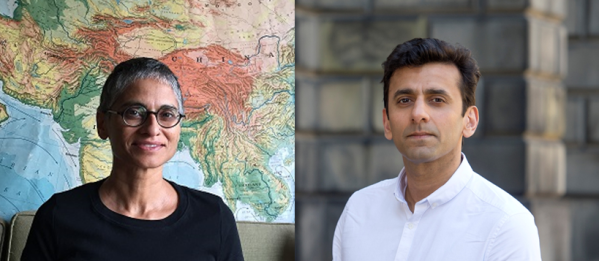
Mariko Hayashi, Executive Director at Southeast and East Asian Centre (SEEAC) talks to IRIS Seb Rumsby about the challenges facing Southeast and East migrants and diasporas based in the UK, before comparing post-Brexit UK with East Asian labour migration regimes to explore how policies lead to labour migrant exploitation and rights abuses and what can... Continue Reading →
Citizenship tests as technologies of bordering: IRiS talk with Kamran Khan, Katie Tonkiss and Tendayi Bloom
Citizenship tests are much more than tests. They often represent forms of ‘linguistic borders’ to be negotiated. Drawing on a decade of work in this area, Dr Kamran Khan will theorise how these borders function beyond their educational role. Furthermore, he will use the concept of ‘becoming’ as a means to centre the individual and... Continue Reading →