
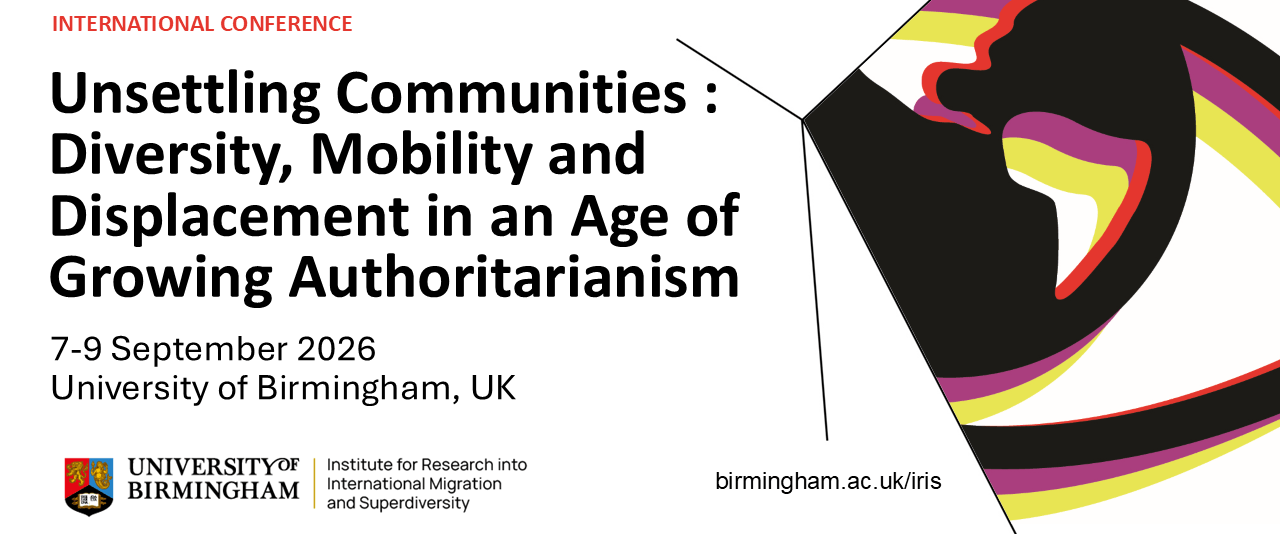
7-9 September, University of Birmingham
CALL FOR PAPERS, PANELS AND WORKSHOPS
Deadline: Monday 16 March 2026, 23:59 (UK time)
All submissions via the online submission page.
Confirmed speakers include: Adrian Favell; Lucy Mayblin; Ipek Demir; Peter Walsh; Ida Danewid; Amani Hassani; Julia Suarez-Krabbe; Jonathan Darling; Zoe Bantleman; Ernesto Castaneda
We are living in times where profound and intersecting geopolitical, economic, environmental and ideological crises are shaping diversity, mobility and displacement. Armed conflicts and protracted wars—from Ukraine to Gaza—continue to displace millions, while climate breakdown, a widespread drift towards authoritarian rhetoric and far-right politics alongside economic collapse drive large-scale mobility and immobility across and within regions, including from Venezuela, across the Sahel, and throughout Central America. The current world order is thus increasingly characterised by change and instability. These changes have major ramifications including intensifying border violence, the introduction of increasingly selective mobility regimes and the erosion of international protection frameworks. Faced with this disruption, political and activist communities are forging new alliances across difference and mobilising in radical new ways to re-imagine collective power and belonging.
Globally, migration has become a central terrain of political contestation. Anti-immigration politics, resurgent racisms and exclusionary nationalisms are increasingly mainstreamed, accompanied by the targeting of racialised citizens and migrants through policing, surveillance, welfare restriction and labour market control. In the US, renewed violent attacks on migrants and their allies, the expansion of enforcement and detention, and assaults on DEI initiatives signal a broader backlash against those perceived as non-white. In Europe and the UK, similar dynamics unfold through externalisation, border violence, deterrence, and the normalisation of emergency governance.
These developments coincide with sustained attacks on international human rights norms and institutions, including the UN refugee regime, the humanitarian work of WHO and IOM, humanitarian law and the principle of asylum itself. The result is a deeply uneven landscape of mobility and immobility, where protection is increasingly conditional, racialised and politicised and the wellbeing of the mobile and the immobilised is undermined.
In this context, the study of diversity, migration and displacement is both more urgent and more challenging than ever.
How can scholarship respond to these transformations without reproducing dominant framings of crisis, threat or invasion? What concepts, methods and alliances are needed to understand—and contest—this moment?
We invite paper, panel and workshop proposals that speak to IRIS’s core research concerns around diversity, belonging, mobility and displacement, understood as historically grounded, politically contested and unevenly lived. Submissions may engage one or more of the following interconnected themes:
Migration, geopolitics and regimes of belonging
- War, occupation, climate breakdown and forced displacement, including slow-onset environmental emergencies, and their gendered and racialised impacts
- Global inequalities, colonial legacies and uneven mobility regimes
- Citizenship, asylum and international protection, including denaturalisation, conditional belonging and the erosion of human rights frameworks
- Racialised citizenship, immigration enforcement and anti-immigration politics.
Borders, enforcement and hostile environments
- Border regimes, externalisation, detention, deportation and surveillance
- Everyday bordering, legal precarity and processes of irregularisation, including intersectional experiences of insecurity
- Labour markets, exploitation and migration control, including algorithmic governance and data infrastructures, and their implications for gendered and racialised labour.
- Language borders and the (re)production of inequalities
Diversity, belonging and diasporic life
- Diasporas, transnationalism and diasporic conviviality, attentive to gender, generation and class
- Urban diversity, neighbourhoods and everyday encounters, including intersectional dynamics of inclusion and exclusion
- Race, racism and racialisation in migration and settlement
- Culture, representation, narratives and memories of migration, and whose voices are made visible or marginalised
- Childhood, youth, education and generational dynamics in contexts of migration, displacement and settlement
Mental health, wellbeing and care
- Sexual and gender-based violence in the context of displacement and asylum
- Refugee and migrant mental health and psychosocial wellbeing, including gendered and racialised dimensions of distress and resilience
- Care, social reproduction and intergenerational dynamics in migrant lives
- Access to health, welfare and social support across insecure legal statuses
Resistance, organising and alternative futures
- Migrant-led struggles, solidarity, political mobilisation and collective organising, including feminist, anti-racist and worker-led movements
- Sanctuary practices, mutual aid and forms of care from below
- Reimagining borders, belonging, rights and futures of mobility
Methods, ethics and knowledge production
- Ethical challenges of researching displacement, diversity and precarity, including power relations, positionality and care in research practice
- Participatory, co-produced, and community-engaged research, collaboration and strength based approaches
- Arts-based, visual, historical and experimental approaches to migration research
We particularly welcome interdisciplinary, comparative and methodologically innovative contributions, as well as proposals that connect academic research with policy, practice, activism and creative work.
Practicalities
Abstracts for papers, panels and workshops should be submitted electronically, using the online submission page by 16 March 2026:
Formats: Papers, panels and workshops
We welcome paper, panel and workshop proposals for IRIS 2026 international conference, to be held in Birmingham, UK on 7-9 September 2026.
Proposals should be submitted electronically following the guidelines below, using this online form by Monday 16 March 2026.
The following types of submission are accepted:
1) Individual paper: Submissions should include author/s, title, abstract (max 250 words) and a short biographical note (max 50 words) including details of the author(s)’ position and institutional affiliation.
2) Organised panel (a set of 3 or 4 papers with a chairperson and a discussant):
Please submit a panel title and abstract (maximum 250 words), including the name of the chairperson and discussant. In addition, provide for each paper: the author(s), paper title, abstract (maximum 250 words), and a short biographical note (maximum 50 words).
3) Organised workshop (including up to six speakers and a chairperson):
Submissions should include a workshop title and an overview abstract (maximum 500 words) explaining the rationale and key questions to be discussed in the session. Please also list the speakers and chairperson, including their position and institutional affiliation. Workshops are intended to create a space for more informal and interactive discussion around core and emerging themes in migration studies.
Submission deadline: 16 March 2026 (23:59 UK time)
Notification of acceptance: 30 April 2026
The conference will include keynote lectures, plenaries, semi-plenaries, panels and workshops. Parallel panels and workshops will be allocated a 90-minute slot.
Conference fees, travel and accommodation will be covered by participants. Concessions will be available for PhD researchers, activists, practitioners and people directly affected by the issues under discussion, including asylum seekers and refugees. A limited number of registration fee waivers will be available for participants from disadvantaged backgrounds.
For further information, please contact School of Social Policy and Society Event Team: spsevents@contacts.bham.ac.uk


 The Age of Superdiversity