
IRiS team ( Nando Sigona, Laurence Lessard Phillips, and Rachel Humphris) to lead new research on the impact of Brexit on EU nationals and their families in the UK.
Mapping the biopolitics of EU membership

IRiS team ( Nando Sigona, Laurence Lessard Phillips, and Rachel Humphris) to lead new research on the impact of Brexit on EU nationals and their families in the UK.
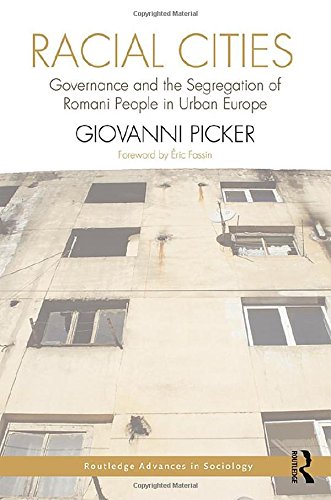
Dr Giovanni Picker recently joined IRiS as a Marie Sklodowska-Curie Research Fellow. Dr Picker's latest book Racial Cities: Governance and the Segregation of Romani People in Urban Europe is now available through Routledge. Racial Cities is the first comprehensive analysis of the segregation of Romani people in Europe, providing a fine-tuned and in-depth explanation of this phenomenon.... Continue Reading →

A great deal of attention has been placed upon the numbers of migrants arriving in Europe with far less concern paid to how those migrants might be supported to integrate into European societies. Researchers at Birmingham have undertaken studies looking at what works in migrant integration and identifying good practice in migrant integration. They have also... Continue Reading →

The University of Birmingham is at the forefront of research into migration and displacement. The Birmingham Heroes campaign is celebrating the work being carried out at the Institute for Research into Superdiversity (IRiS), the first institute in the UK and one of the first globally, to focus on migration, displacement and superdiversity. The ongoing ‘refugee... Continue Reading →

With growing media and public focus on two distinct areas of public policy; migration and healthcare, do we understand the interrelation between them? A recent IRiS project, led by Dr Antje Lindenmeyer examined the health histories of migrants in Birmingham, helping to uncover key insights into their health seeking behaviours and the impact this has... Continue Reading →

IRiS Nando Sigona has edited a collection of essays on citizenship, undocumented status and youth with Roberto Gonzales of Harvard University and Edelina M Burciaga of the University of Colorado at Denver. The American Behavioral Scientist issue draws on contributions to a symposium organised at the Harvard Graduate School of Education in Fall 2013 and... Continue Reading →

With an increasing number of migrant children reported missing in Europe, questions arise about the availability, coverage and reliability of data on children migrating to and through the European Union.
Rachel Humphris and Nando Sigona analyses the evidence base in the latest IOM Global Migration Data Analysis Centre Data Briefing Issue 5, released on 2nd September.
It is estimated that over 250,000 child migrants crossed irregularly into Italy and Greece in 2015. For Italy, of 16,500 child migrants, over 12,000 (72 percent) were unaccompanied. For Greece, no official distinction between accompanied and unaccompanied is made at entry for the purposes of data collection, although the UN refugee agency (UNHCR) estimates that at least 10 percent arrived without parents or guardians.
“Child migration into Europe is diverse and often invisible in data and policy. European States consider children as “accompanied” or “unaccompanied” differently. This not only affects the rights and entitlements…
View original post 187 more words

The University of Birmingham’s Institute for Research into Superdiversity (IRiS) is an interdisciplinary centre of excellence for research and teaching on diversity, migration and social inequality. The Institute currently engages in international research related to the refugee crisis, asylum policy and practice, superdiversity, undocumented migration, migrant children and youth, socio-economic inequality and diversity, welfare state... Continue Reading →

2015 has been a really busy and successful year for IRiS. Our highlights for 2015 include a number of new high profile research projects as well as numerous publications and research related events around superdiversity and migration. Jenny Phillimore's UPWEB hit the street this year with fieldwork in full swing. The study is funded by NORFACE... Continue Reading →
The University of Birmingham offers a number of ESRC scholarships for students commencing their studies in October 2016 to fund postgraduate training and doctoral research, with both +3 (PhD) and 1+3 (Masters and PhD) funding available. A full ESRC scholarship comprises research fees, an annual Research Council stipend (please see RCUK minimum stipend amounts) and a research... Continue Reading →


 Conversations with Iris: Podcast on migration, diversity and displacement

