We asked our researchers to pick one of their publications from 2025 and share why it stands out for them. Here's what they replied!1) Let's start with the introduction to a Special Issue on "#RefugeeSponsorship & Complementary Pathways" edited by our refugee sponsorship research team (Jenny Phillimore, Marisol Reyes, Gabriella D'Avino, Natasha Nicholls). It's the... Continue Reading →
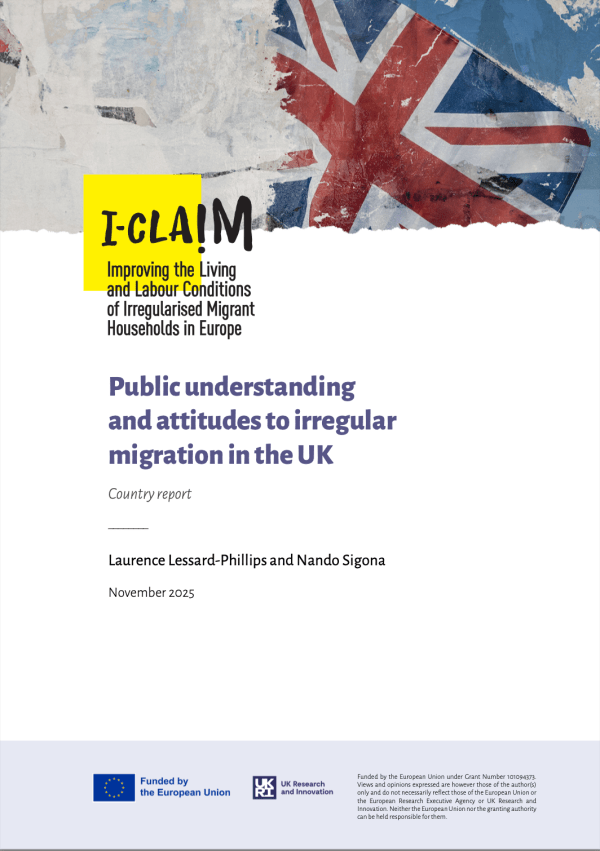
Most Britons vastly overestimate the number of irregular migrants, new research shows
A new report has revealed major gaps in UK public understanding of irregular migration, which is shaped by political media narratives rather than facts. A new report published today (11 December), by researchers at the University of Birmingham, reveals widespread misconceptions among the UK public about irregular migration, which includes all unauthorised methods of entering... Continue Reading →
Irregular migration as an assemblage: New IRIS Working paper unpacks how “irregularity” is made in Europe
Written by Nando Sigona (University of Birmingham) and Ilse van Liempt (Utrecht University), The irregularisation of migration and migrants’ irregular condition: an assemblage perspective draws on research across six European countries — Finland, Germany, Italy, the Netherlands, Poland and the United Kingdom — carried out as part of the I-CLAIM project, to propose a new way of thinking... Continue Reading →
Delivery riders caught between algorithmic control and immigration raids
In a new analysis piece for OpenDemocracy, Nando Sigona and Stefano Piemontese draws on the I-CLAIM research in the UK with food delivery riders to examine how the cosying up of Home Office and platform employers is impacting on food delivery workers. https://nandosigona.info/2025/08/08/the-home-office-is-everyone-delivery-riders-caught-between-algorithms-and-immigration-raids/?page_id=5535
Research exposes structural exploitation of migrant workers in UK domestic and food delivery sectors
Reports document the lived experiences of migrant workers experiencing legal vulnerability in the UK’s food delivery and domestic work sectors A team of researchers at the University of Birmingham, led by Professor Nando Sigona, has released two new reports exposing how migrant workers experience exploitation and legal vulnerability in the UK’s food delivery and domestic... Continue Reading →
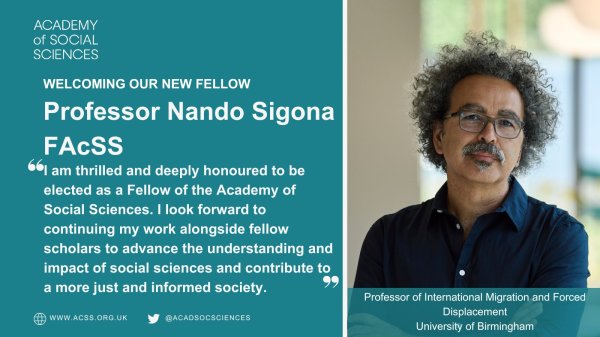
IRIS director elected Fellow of the Academy of Social Sciences
The Academy of Social Sciences is delighted to welcome 45 leading social scientists to our Fellowship this autumn. Spanning a range of research and practice areas including urban governance and public policy, health technology assessment, hunger and food insecurity, migration and forced displacement, and international law, our newly elected Fellows highlight the importance, breadth and... Continue Reading →
One week to IRIS conference
Check out the latest version of the Conference programme, which includes 33 panels, 5 workshops, 4 semi-plenaries and two keynote talks by Nandita Sharma and Nasar Meer. The code of conduct for delegates is also online on our conference page. The book of abstracts is now online!
UKICE report on migration to the UK after Brexit
Immigration, while far less salient than it was in 2016, is becoming a key political and policy issue again, partly due to Farage's effort to shift the debate on a terrain more congenial to him. This report not only analyses what has changed in terms of both outcomes and public opinion but considers how a... Continue Reading →
Publication alert: The UK’s ‘Safe and Legal’ Humanitarian Routes: from Colonial Ties to Privatising Protection in The Political Quarterly
In this new article published in The Political Quarterly, the MIGZEN team examines the UK's ‘safe and legal (humanitarian) routes’ and their position in the post-Brexit migration regime. It considers also how these domestic provisions compare to those underwritten by international protections. The Hong Kong British Nationals (Overseas)—HK BN(O)s—and Ukraine visa schemes are an area... Continue Reading →
Who really benefits from international labour migration? New IRIS Working Paper on the everyday political economy of labour migration
By Seb Rumsby IOM World Migration Report 2024 found that international remittances had increased 650% from $128bn to $831bn between 2000 and 2022. This growth continued contrary to predictions that remittances would drop dramatically during COVID-19. Remittance figures now outnumbers foreign direct investment in developing nations for the first time, highlighting the critical importance of labour... Continue Reading →