
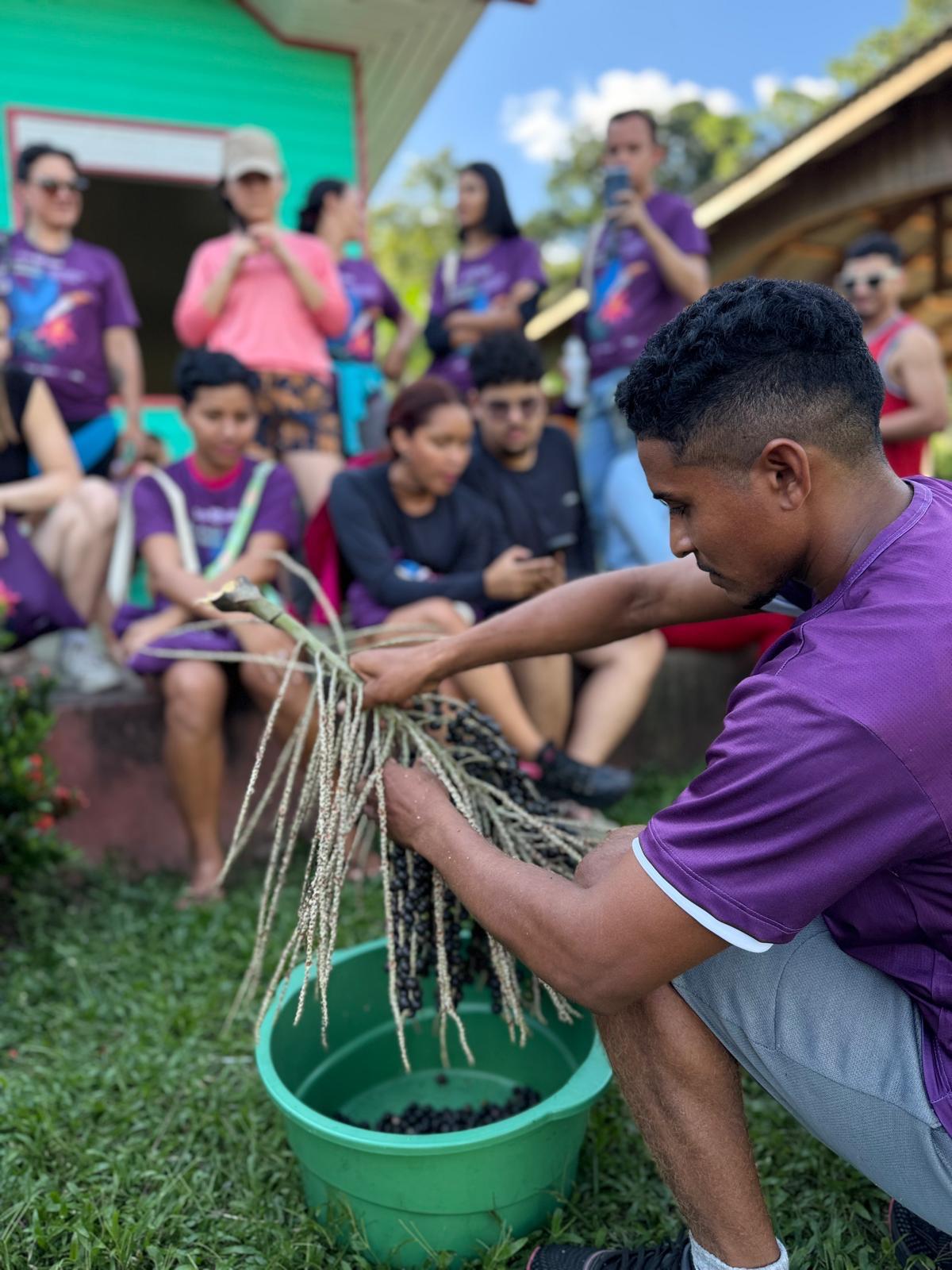
July 2025 marked a significant month for the Institute for Research into International Migration & Superdiversity (IRiS) in Brazil, as Dr Angelo Martins Junior represented the University of Birmingham in a series of academic, diplomatic, and community-focused activities across the country. His engagements spanned the Amazon, São Paulo, Campinas, and Brasília, deepening IRIS’ international collaborations and reinforcing its mission to connect research with real-world impact.
Immersive learning in the Amazon: UBBI Summer School
Dr Martins Junior’s visit began with the inaugural Immerse Amazonia summer school, part of the University of Birmingham Brazil Institute’s (UBBI) Engage Amazonia programme, jointly organised with the Museu Paraense Emílio Goeldi in Pará. Bringing together students and academics from Brazil and the UK, the two-week binational field school focused on challenge-led learning around biodiversity loss, climate change, migration, and social inequality.
Participants prepared through pre-immersion sessions on sustainability, decolonial perspectives, and traditional knowledge, before travelling from Belém to deep into the Caxiuanã National Forest. There, interdisciplinary teams developed educational resources aimed at engaging the public, informing policy, and inspiring young learners. The summer school demonstrated the power of co-produced knowledge, situated in the unique cultural and environmental context of the Amazon. By situating learning in the Amazon itself, the summer school created a rare space where academic theory, environmental stewardship, and social justice came together.
Strengthening UK–Brazil partnerships: UBBI delegation visit
Following the summer school, Dr Martins Junior joined the UBBI delegation for a series of strategic visits. At the British Consulate in São Paulo, the delegation participated in the Global Leaders Dialogue, meeting Ambassador Stephanie Al-Qaq. Brazilian and British students shared their reflections to the Ambassador on the Amazon field experience, highlighting the value of immersive, cross-cultural education.
In Campinas, the delegation attended the Brazil–UK Environment and Climate Change Workshop at UNICAMP, fostering bilateral cooperation in biodiversity, climate action, and sustainability. Representing IRiS, Dr Martins Junior broadened the conversation by connecting environmental challenges to themes of migration, inequality, and superdiversity.
The visit concluded in Brasília with discussions at CAPES, Brazil’s federal postgraduate education agency. Here, Dr Martins Junior signed the Abdias do Nascimento Agreement, committing the University of Birmingham to host postgraduate researchers from historically marginalised Brazilian communities. The three-year programme will welcome scholars from Afro-Brazilian, Indigenous, and Quilombola backgrounds, reflecting a shared UK–Brazil commitment to racial justice and inclusive academic mobility.
Advancing impact evaluation: Workshop at UNESP São Paulo
Dr Martins Junior’s Brazilian itinerary concluded with a two-day workshop at São Paulo State University (UNESP), organised by the Office of the Pro-Rectory for University Outreach and Culture (Proec). Entitled Technology Transfer and the Social Impact of University Outreach, the workshop focused on how to gather evidence and evaluate the societal impact of university outreach activities—a growing priority within Brazilian higher education. The workshop participants were composed by members of the UNESP’s Office of the Pro-Rectory, including Prof. Raul Borges Guimarães and Prof. Maria Eugênia Porem.
Sharing UK methodologies and insights from his own impact-focused research, Dr Martins Junior presented frameworks used at the University of Birmingham to assess how research influences public policy, health, inequality, culture, and the environment. The workshop led to the creation of a new working group, University, Society and Social Impact, and the beginning of a cooperation between UNESP and IRiS, laying the groundwork for future joint initiatives.
New Research: Climate change, migration, and (im)mobility in the Amazon
As part of IRiS’s deepening engagement in Brazil, the institute will now lead new research on the intersections of climate change, migration, and (im)mobility. The UBBI–FAPESPA Connect Amazonia funded project, Climate Emergencies, (Im)Mobility, and Citizenship in the Brazilian Amazon: Governance and Strategies of Riverine Communities under Environmental Pressure, is led by Dr Martins Junior (PI) in collaboration with Prof Nando Sigona (UoB/IRiS), Prof Augusto Carvalho (UEPA), Prof Rodrigo Constante Martins (UFSCar), and Prof Nirvia Ravena (UFPA).
The study will explore how climate change-driven drought affects mobility, access to rights, and citizenship among riverine communities in the Resex do Rio Iriri, a remote extractive reserve in Pará. Rather than depicting these communities as passive ‘climate refugees’, the project will foreground their strategies and agency in coping with environmental disruption, co-producing knowledge and policy recommendations with local residents. Aligning with SDGs on Climate Action, Reduced Inequalities, Life on Land, and Inclusive Institutions, the project positions IRiS at the forefront of research linking environmental change to the lived realities of mobility and belonging.
Building long-term impact
Across these engagements, IRiS’s presence in Brazil in July 2025 underscored the value of international collaboration in addressing complex global challenges. From the Amazon rainforest to federal agencies and urban universities, the activities linked environmental sustainability with social justice, migration, and diversity. Through immersive learning, strategic partnerships, cutting-edge research, and capacity-building workshops, Dr Martins Junior’s visit exemplified IRiS’s commitment to research that is not only academically rigorous but also transformative for the communities it serves.


 The Age of Superdiversity
Leave a comment